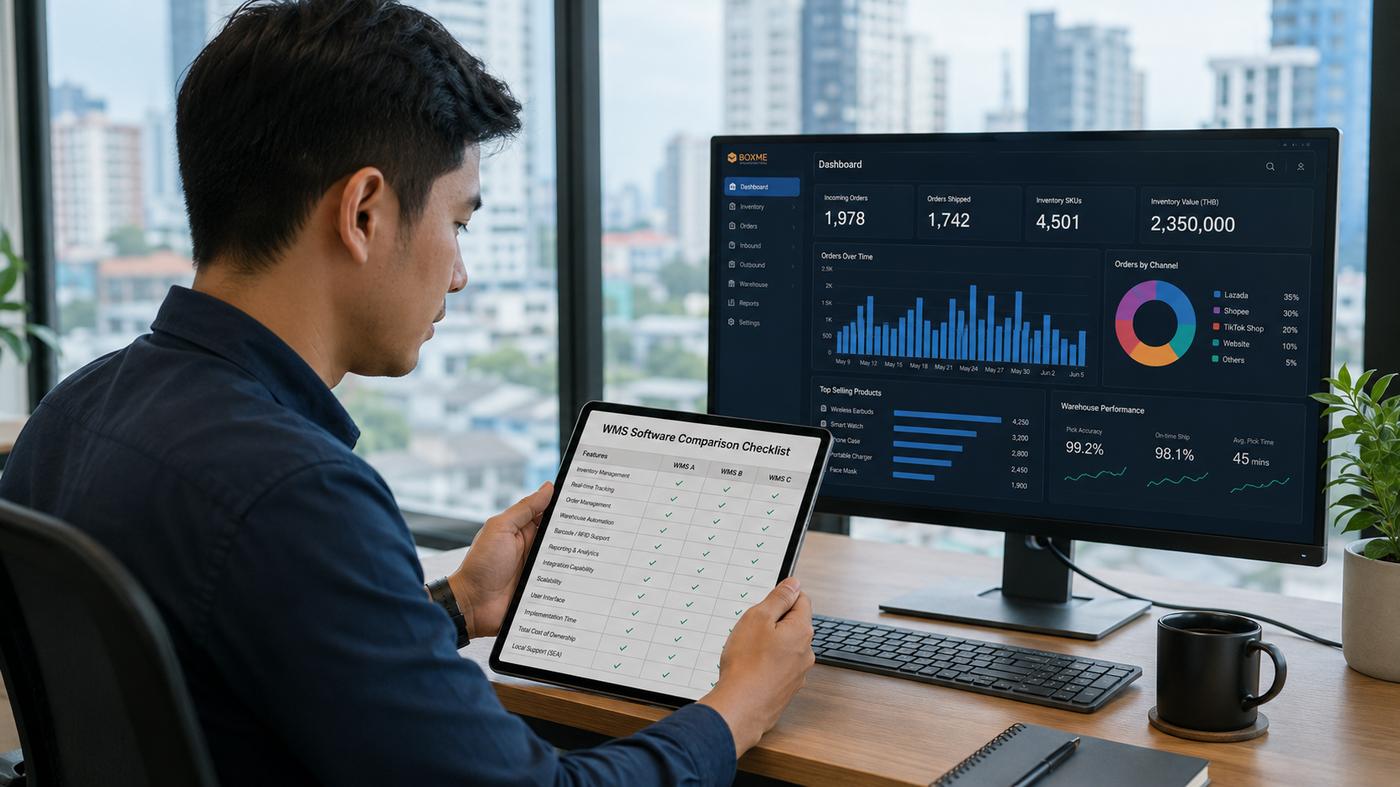
The WMS market is crowded — from SaaS tools at a few hundred dollars a month to enterprise custom systems costing hundreds of thousands. Feature descriptions vary widely, prices vary even more. Most companies fall into the same trap: they evaluate features first, get impressed by a demo, and only discover the mismatch after going live.
The right order is the reverse: first understand your business type, then assess systems against five core dimensions, then look at specific products. This article follows that order.
Step 1: identify your business type first
Different business types have very different core WMS requirements. The same feature set may be essential for one type and completely irrelevant — even counterproductive — for another.
Type A
🏭 3PL / fulfillment provider
Serving multiple clients simultaneously; shared space and labor; must manage each client's inventory, billing, and access permissions independently.
🔑 Must-have: multi-client isolation, billing module, client data portal, SLA monitoring
Type B
🛒 E-commerce brand / seller
Self-owned brand selling across multiple e-commerce platforms; need unified outbound from one warehouse with real-time inventory sync to all channels.
🔑 Must-have: multi-platform order aggregation, real-time stock sync, oversell prevention, pick wave management
Type C
🏪 Traditional business going e-commerce
Existing wholesale or retail base, adding e-commerce channels; need to separate e-commerce stock from wholesale warehouse flow; UI simplicity is critical.
🔑 Must-have: local language UI, quick onboarding, basic bin management, no IT team dependency
Type D
🌏 Cross-border brand / Southeast Asia expansion
Brand from China or other markets, warehousing across multiple Southeast Asian countries; needs cross-border inventory visibility, multi-currency, local carrier integrations, compliance support.
🔑 Must-have: multi-warehouse management, multi-currency reporting, local courier integrations, cross-border stock transfer
Once you've identified your business type, the five dimensions below are the core questions every type needs to assess — with different weights for each.
Step 2: five core evaluation dimensions
1
Platform Integration Capability (Top priority for e-commerce brands)
The main battlegrounds in Southeast Asian e-commerce are Shopee, Lazada, and TikTok Shop. A WMS must be able to integrate directly with all three: automatic order download, two-way inventory sync, automatic waybill printing. Manual export-import is both slow and the main source of errors.
Distinguish between "supports API integration" (you need to build it) and "has certified integrations" (ready out of the box).
Distinguish between "supports API integration" (you need to build it) and "has certified integrations" (ready out of the box).
Ask in the demo: Are Shopee Thailand / TikTok Shop official integrations certified? How quickly do stock changes sync to platforms? What's the order pull latency from platform to WMS?
2
Multi-Client Architecture (A 3PL's non-negotiable)
The core business logic for a 3PL is: one physical warehouse, multiple clients, with inventory, accounting, and data completely separated. This can't be solved with "notes" or "tags" — the WMS architecture must support multi-tenant mode at the system level.
Clients also need individual portals to view their own stock and outbound history without accessing other clients' data. The billing module must auto-generate invoices by each client's contract terms (inbound/storage/outbound/value-added service fees).
Clients also need individual portals to view their own stock and outbound history without accessing other clients' data. The billing module must auto-generate invoices by each client's contract terms (inbound/storage/outbound/value-added service fees).
Ask in the demo: Can you demo inventory isolation between two different clients? Does the billing module support custom rate cards? Is the client portal real-time or delayed?
3
Peak load capacity and stability (critical for everyone)
Southeast Asian e-commerce has dense campaign calendars: Shopee's 9.9, 10.10, 11.11, 12.12, plus the normalization of live commerce peaks — every month brings multiple order surges. A system that runs smoothly in normal times is table stakes; not breaking under peak load is the real capability.
Many vendors gloss over this in demos. Ask directly: historical downtime records, system response time during peak periods, SLA commitments, and what happens to your business if the system goes down during a campaign.
Many vendors gloss over this in demos. Ask directly: historical downtime records, system response time during peak periods, SLA commitments, and what happens to your business if the system goes down during a campaign.
Ask in the demo: When was the last system outage, and how long did it last? What peak concurrent orders did you handle on 11.11? Is the system SLA 99% or 99.9% uptime?
4
Implementation support and localization (consistently underestimated in Southeast Asia)
In Southeast Asia, WMS deployment is consistently harder than expected. Three reasons: language (warehouse operators often don't read English), timezone (it's 10am in Bangkok, your vendor in Beijing just arrived at the office, and the European team is asleep), and local carrier integrations (Flash Express, J&T, Kerry API integrations are non-trivial without local experience).
Ask explicitly: where is the implementation team based, what languages do they support, and what is the post-go-live response time for issues. "Has Thai language UI" and "has a local Thai support team" are not the same thing.
Ask explicitly: where is the implementation team based, what languages do they support, and what is the post-go-live response time for issues. "Has Thai language UI" and "has a local Thai support team" are not the same thing.
Ask in the demo: Are Flash Express and J&T Thailand integrations live in production? Is your implementation team based locally in Thailand (or your target market)? What is your committed post-live support response time in hours?
5
Total Cost of Ownership (More than just the monthly fee)
The real cost of a WMS is typically 30–50% higher than the quoted price, because several cost items aren't captured upfront: implementation fees (typically 3–6x the monthly subscription), data migration, training, integration development (for any connected systems), and annual version upgrade fees.
Also distinguish three cost models: SaaS subscription (monthly, predictable, fast updates, good for SMEs); perpetual license (one-time purchase, may have maintenance fees, better for large stable operations); per-order/per-SKU billing (friendlier for hypergrowth phases, limits upfront risk).
Also distinguish three cost models: SaaS subscription (monthly, predictable, fast updates, good for SMEs); perpetual license (one-time purchase, may have maintenance fees, better for large stable operations); per-order/per-SKU billing (friendlier for hypergrowth phases, limits upfront risk).
Ask in the demo: Beyond the monthly fee, what is the realistic total first-year investment including implementation, training, and integrations? Is per-order billing available? If volume drops, can the fee adjust accordingly?
Selection guidance by scale and business type
| Monthly orders | 3PL Provider | E-commerce brand | Traditional business |
|---|---|---|---|
| <500 | WMS not yet needed | Platform dashboard + Excel | Platform dashboard + Excel |
| 500–5,000 | Basic WMS + multi-client | Basic WMS + platform sync | Lightweight WMS, simple UI first |
| 5,000–30,000 | Full WMS + billing + client portal | Full WMS + OMS integration | Full WMS + analytics |
| >30,000 | Enterprise WMS or custom dev | WMS + OMS + automation integration | Consider outsourcing to 3PL |
Four most common selection mistakes
❌ Trap 1: Impressed by the feature list, not tested against actual workflows
Vendor demos always show the smoothest scenarios. The right approach: prepare 3–5 of your most complex real-world scenarios before the demo (e.g., 500 orders flooding in after a live session ends; a SKU selling out simultaneously on Shopee and TikTok; a return that needs inspection and re-listing). Ask the vendor to walk through these live during the demo.
❌ Trap 2: Only looking at the monthly fee, ignoring implementation and integration costs
A system at THB 5,000/month may cost THB 150,000+ in the first year once you add implementation, training, and API integration development. A system at THB 12,000/month with a local Thailand implementation team may actually cost less in year one — because there's no remote communication overhead and rework. Always ask vendors for a full first-year cost estimate.
❌ Trap 3: Over-trusting "big brand" systems while ignoring fit
Globally recognized WMS brands (SAP EWM, Oracle WMS) are designed for large-scale manufacturing and retail, with implementation cycles of 6–18 months, very high prices, and Southeast Asia e-commerce platform support as a non-priority. For a warehouse handling 10,000 orders per month, these systems are overengineered — you'll spend significant time on features you'll never use. By contrast, a WMS built for Southeast Asian e-commerce has fewer features on paper, but faster integration, stronger local support, and a shorter go-live timeline that better matches actual needs.
❌ Trap 4: Excluding warehouse operator input from the selection decision
A WMS is ultimately a tool that warehouse operators use every day, not a management reporting dashboard. If the interface is complex and requires multiple steps to complete a single scan-to-pick action, operators will work around the system or generate constant errors. Before the final decision, have 3–5 frontline operators trial the system. Their feedback is often more valuable than any feature comparison table.
Pre-selection self-assessment checklist
Before contacting any WMS vendor, confirm you've worked through these:
What is my business type (3PL / brand / traditional transition / cross-border)?
What are my current monthly orders? What is the 12-month forecast?
Which platforms am I selling on? Do I need direct WMS integration for each?
If 3PL: how many clients now? How many expected in 12 months?
How many SKUs does my warehouse carry? Which are high-velocity?
Does my team have IT capacity to build integrations? Or does the vendor need to handle everything?
What is the budget range (including implementation)? Preference for monthly SaaS or perpetual license?
What 3 real workflow scenarios have I prepared to test in vendor demos?