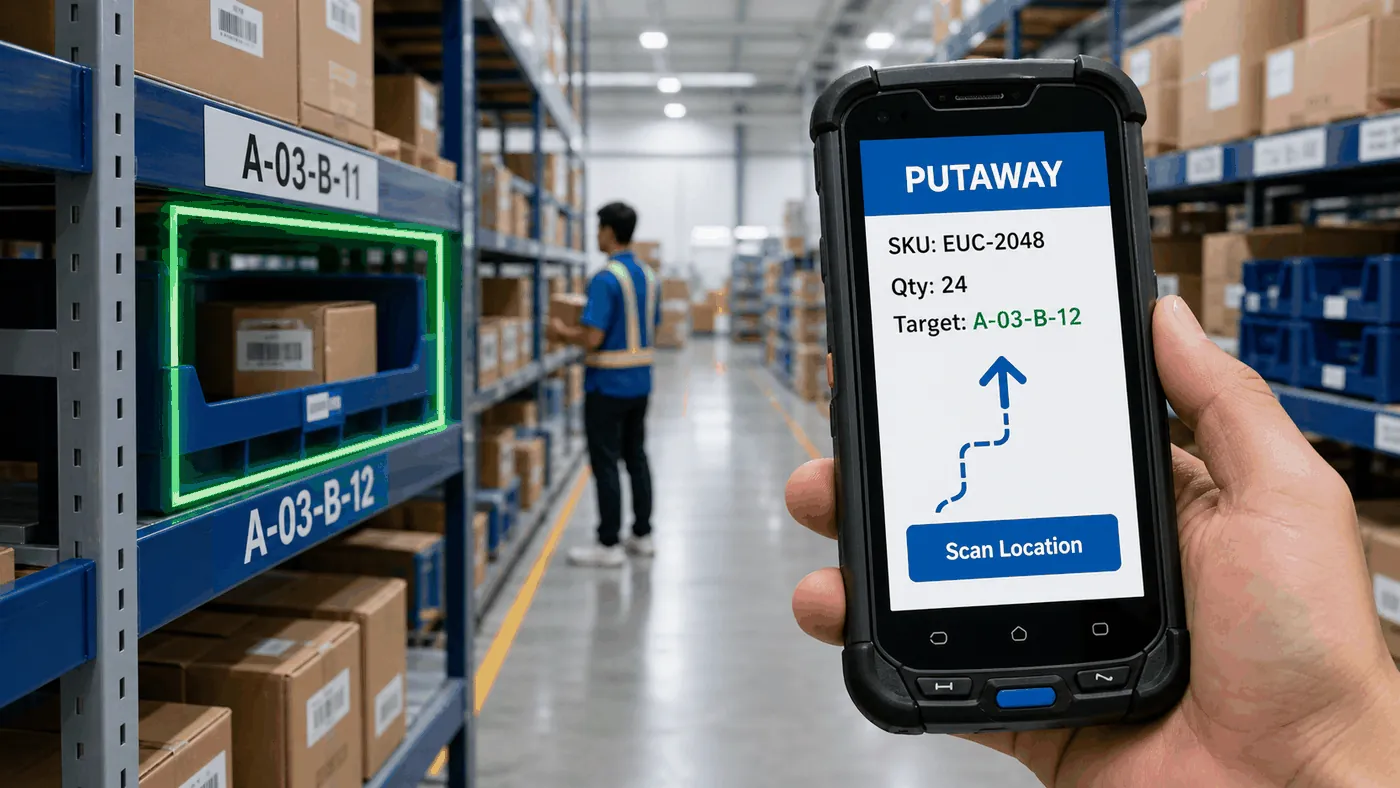
Ask most warehouse managers what their inventory accuracy rate is and they'll say "pretty good" or "around 95%." Ask them how they measured it and the answer is usually: the annual physical count. That's the problem. A once-a-year count tells you where you ended up — it doesn't tell you how many orders were cancelled, how many customers waited, or how many pickers wasted time searching for stock that wasn't where the system said it was throughout the year.
What inventory accuracy actually means in practice
Inventory accuracy = (number of SKU locations with correct quantity and location in system) ÷ (total SKU locations counted). Here's what different accuracy levels look like when you have 5,000 active SKU locations:
The jump from 95% to 99.5% cuts your error locations by 80%. That's the difference between a picker who trusts the system and one who double-checks every location before reporting a short-pick.
The real causes of inventory inaccuracy
Managers usually blame theft or mistakes. Those contribute — but they're rarely the main cause. The main causes are systemic:
-
Manual data entry
Any time a person types a quantity instead of scanning it, errors enter the system. Staff type the wrong number, transpose digits, or skip entries entirely when busy. Each manual entry is a chance to create a discrepancy that compounds over time.
-
Receiving errors that compound downstream
Inaccuracy enters the system at receiving and multiplies from there. A carton counted as 12 units when it actually contains 10 creates a phantom 2-unit surplus that will eventually surface as a discrepancy during picking — potentially weeks or months later.
-
Items stored wherever there's space
When staff put stock "anywhere there's room" instead of at a designated location, the system location no longer matches reality. No one updates the system record. The stock physically exists but is effectively invisible to the WMS until someone physically finds it.
-
Unrecorded movements — transfers, returns, adjustments
Stock transfers between locations, returned items re-shelved without being processed, damaged goods moved to a quarantine zone without a system transaction — every unrecorded movement silently breaks the system record. These accumulate invisibly until the next count reveals the damage.
The 4 practices that get you to 99.5%
-
1Scan every movement — no exceptions
The single highest-impact change you can make. Every receive, every put-away, every pick, every transfer, every return must be recorded by scanning a barcode — not by typing a number, not by memory, not by writing it down to enter later. WMS enforces this by making the scan the only way to complete a task. If staff can bypass the scan, they will — especially under pressure.
-
2Every SKU has designated locations — no random put-away
Random storage (put items wherever there's space) destroys accuracy. The fix isn't necessarily "one bin per SKU" — high-velocity SKUs often need a primary pick face plus one or two overflow locations. What matters is that every location for a SKU is registered in the WMS, and staff put away only to those locations. When a picker is directed to A3-04-02, the item is there, every time. WMS enforces this through put-away rules that reject unregistered locations at scan time.
-
3Replace annual counts with daily cycle counting
Cycle counting means counting a portion of your inventory every day, so that every location gets verified on a regular schedule — without shutting down the warehouse. It catches errors fast, when they're easier to investigate. Annual counts find errors months after they happened; cycle counts find them within days.
Count type Frequency Which locations A-class (fast movers) Every 30 days Top 20% of SKUs by volume B-class (mid movers) Every 60 days Middle 30% of SKUs C-class (slow movers) Every 90–180 days Bottom 50% of SKUs Triggered count After any discrepancy found That location + adjacent bins -
4Get receiving right — errors compound from the start
Inaccuracy almost always enters the system at receiving. An item received wrong propagates through every subsequent transaction — it's picked incorrectly, shipped incorrectly, and eventually generates a customer complaint or return. Receiving discipline means: count against the PO before putting away, scan every item, reject or quarantine mismatches, and never bypass receiving to put stock directly on the shelf.
Why 99.5% is hard without a WMS
You can implement all four practices manually — but enforcing them without a system requires constant management attention and still relies on human compliance. A WMS changes the equation by making compliance the path of least resistance:
- Can't complete a task without scanning — the system won't let the transaction proceed without a valid scan, so staff have no choice but to scan
- Wrong location rejected at put-away — scan the wrong bin and the WMS flags it immediately, before the item is stored in the wrong place
- Discrepancies flagged during picking — when a picker can't find stock at the directed location, the short-pick is recorded in real time, triggering an immediate cycle count
- Every movement has a timestamp and user ID — when a discrepancy is found, you can trace exactly when it happened and who was involved, making root cause analysis possible instead of guesswork
99.5% accuracy isn't a standard you reach and hold effortlessly. It's a standard you build a system to defend — and then defend it every day.