Southeast Asia has the world's fastest-growing e-commerce market, and more Chinese brands, factories, and cross-border sellers are entering every month. But the first operational question — how to handle warehousing — rarely gets a careful answer. Many just find somewhere to store goods and move on, only to spend the next six months wrestling with operational chaos.
This article doesn't give you a single "right answer" — because the right answer depends on your scale, category, expansion pace, and resources. Instead, we give you a clear comparison across four dimensions so you can make a decision that fits your current stage.
First, let's define the two options
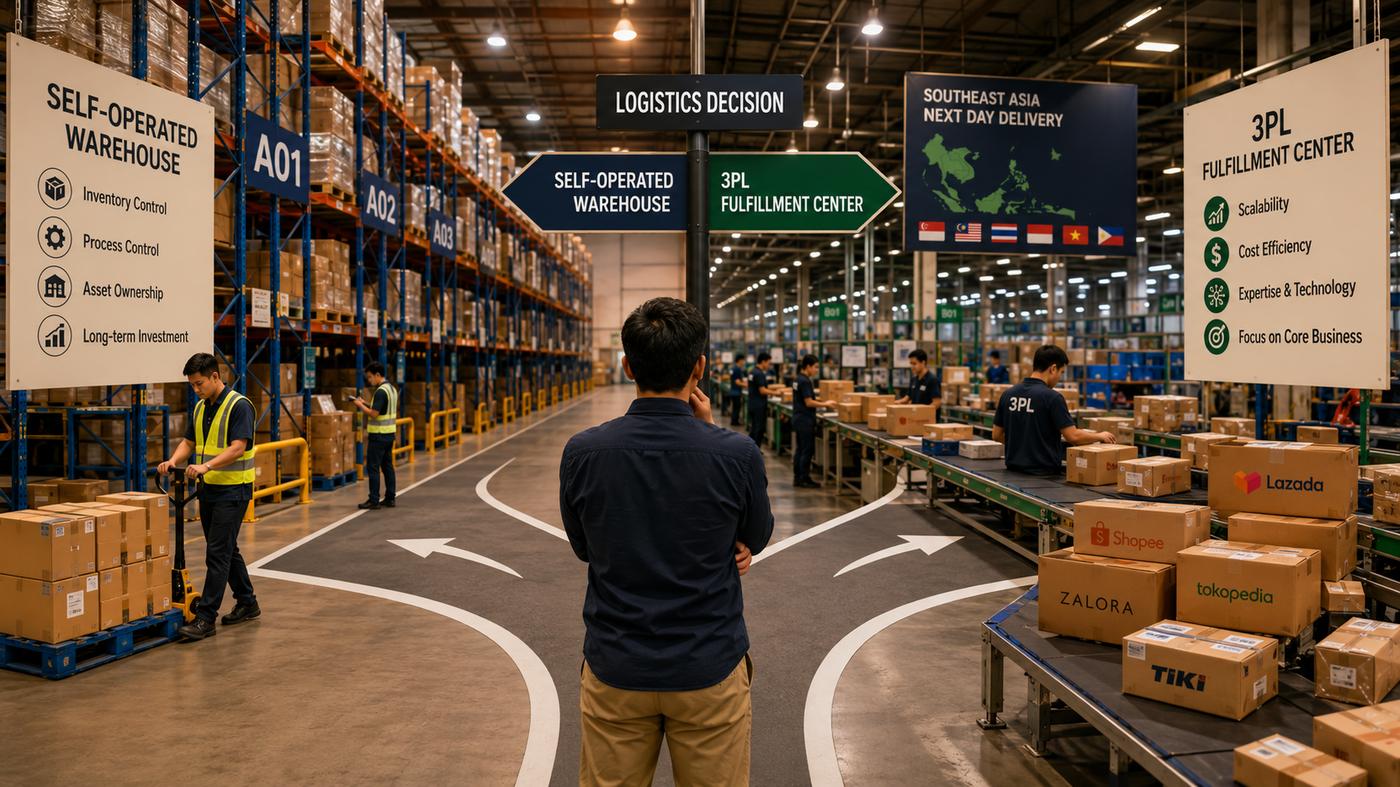
Self-operated warehouse: you lease the warehouse property yourself, hire local staff, procure equipment, and build the operation. The warehouse serves your goods only. Full control, full ownership.
3PL (Third-Party Logistics): you outsource warehousing and fulfillment to a specialist provider. You send inventory; the 3PL handles receiving, putaway, picking, labeling, and shipping. You pay per operation and unit moved — no warehouse management overhead on your side.
Four-dimension comparison
| Dimension | 🏢 Self-operated | 🤝 3PL |
|---|---|---|
| Setup cost | High. Deposit, rent, fit-out, racking, equipment, WMS, and hiring. A mid-size warehouse in a major Southeast Asia city typically runs ¥500K–¥1.5M to stand up. | Low. Typically just a first-month service fee and a small deposit to get started. No capital asset commitment. |
| Operational control | Full. Process, SLAs, packaging standards, relabeling, QC — all on your terms. Brand experience is entirely in your hands. | Limited. You depend on the 3PL's execution and responsiveness. Whether custom requirements (special packaging, kitting, gift sets) can be met depends entirely on the provider you pick. |
| Scalability | Slow. Entering a new market means new site selection, new lease, new fit-out, new hiring — each expansion is a 3–6 month standalone project. | Fast. A 3PL with broad network coverage can plug you into Thailand, Malaysia, Indonesia, and more without you building infrastructure in each country. |
| Long-term cost | The more volume, the lower your unit cost. Once daily outbound orders consistently exceed ~500, your total cost of self-operation typically beats 3PL rates. | Cost-effective at low volume; expensive at scale. 3PL billing (inbound + storage + outbound + handling fees) compounds quickly at high throughput. |
| Local compliance risk | High. Foreign companies operating warehouses in Southeast Asia face local labor law, FX controls, import/export licensing, and fire compliance requirements — all of which vary by country and require significant local legal resources. | Low. Compliance is the 3PL's responsibility. You only need to handle your own customs and import paperwork — not the warehouse operating licenses and labor compliance. |
When should you choose 3PL?
You want to test multiple country markets simultaneously without committing to any one;
Your SKU count is low and operations are simple, with minimal customization needs;
Your team has no local warehousing experience, or can't allocate bandwidth to on-the-ground operations;
You need to establish fulfillment capability within 3–6 months — you can't wait out a warehouse build cycle.
When does self-operation make sense?
You have strong brand experience requirements — relabeling, kitting, gift packaging, QC standards are non-negotiable;
Your category requires special storage conditions (temperature control, humidity, high-value items) most 3PLs can't reliably provide;
You plan to be in this market long-term and the warehouse can become a core competitive asset;
You have a reliable local operating partner or team already in place.
A common trap we've seen
Many brands build their own warehouse before orders have stabilized — usually because they believe "controlling it ourselves is safer" or "3PLs aren't reliable." The result: fixed monthly burn (rent, staff, utilities, systems) against slower-than-expected order growth. By month 12, cash flow is strained, and they're forced to close or scale back — writing off the entire setup investment.
The cost of building your own warehouse overseas isn't just money — it's time and attention. While your team is buried in local hiring, equipment breakdowns, and fire inspections, your product and marketing are starving.
A more pragmatic path
The brands we've seen succeed in Southeast Asia most consistently tend to follow this path:
Phase 1 (0–12 months): Use 3PL to validate the market. Find a 3PL with system integration capability, establish delivery coverage quickly, and test SKU performance, pricing, and return rates. The goal isn't to save money — it's to validate your market assumptions with minimal fixed cost commitment.
Phase 2 (12–24 months): Once volume is there, then consider self-operation. Once the market is proven and orders are stable, use real data to decide whether to build, where, and at what scale. You're now making the decision based on actuals, not projections.