Live commerce fulfillment: orders explode in the stream — is your warehouse ready?
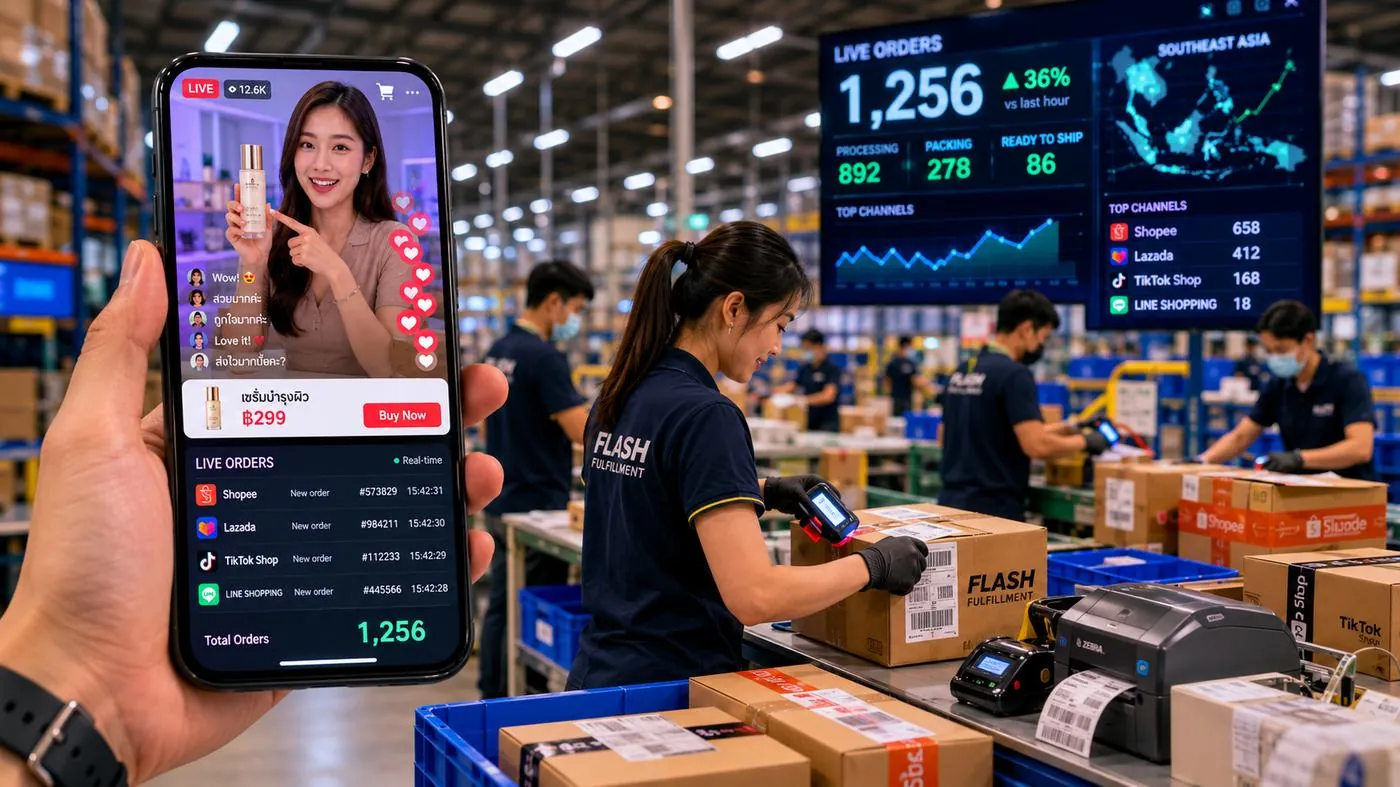
Live-stream orders arrive in sudden bursts, with no reliable forecast and a fulfillment clock that starts the moment someone taps "buy." The warehouse that handles normal daily orders fine can completely fall apart when a single live session sends 20,000 orders in 90 minutes.
TikTok Shop, Shopee Live, and Lazada Live have rapidly made live commerce a mainstream sales channel across Southeast Asia. A successful live session can generate several times — sometimes ten times — a normal day's order volume for a brand. But for the warehouse, that "order explosion moment" isn't a celebration. It's a sudden stress test with no warning.
The fulfillment challenges of live commerce are fundamentally different from regular e-commerce. Understanding that difference is the first step to building warehouse capability that can handle it.
Five core challenges of live commerce fulfillment
Challenge 01
Orders arrive in a sudden burst — no way to smooth the load
Regular e-commerce orders trickle in throughout the day — the warehouse absorbs them evenly. Live orders are different. One "flash sale" announcement from the host, and 500 orders can hit the system in 5 minutes. Without a WMS that handles sudden concurrency spikes, system response slows, picking tasks pile up, and the entire outbound line jams.
Challenge 02
Volume is unpredictable — staffing and stock are both a gamble
Live sales volume depends on the host's performance, platform traffic allocation, pricing, and real-time audience engagement — all highly unpredictable in advance. Too little stock means overselling; too much means dead inventory. Call in extra staff and there's not enough work; don't and you can't ship. The uncertainty makes warehouse resource planning inherently reactive.
Challenge 03
Live-exclusive SKUs and bundles add warehouse complexity
Live sessions commonly feature bundle deals — buy A get B free, three-piece sets, live-exclusive gift boxes. These bundles don't exist in normal inventory; they need to be assembled after the live ends. Manual kitting is slow and error-prone. Non-standard packaging and labeling under time pressure drives mispicks and missed items.
Challenge 04
High return rates — reverse logistics is a hidden cost
Impulse buying is high in live commerce — consumers order in the excitement of the stream, then reconsider. Return rates for live orders in some Southeast Asia categories run 15–25%. Returned goods need inspection, sorting, restocking or disposal. Without a dedicated reverse logistics process, return backlogs corrupt live inventory accuracy and create oversell risk.
Challenge 05
Platform penalties for late shipment directly hurt the account's live traffic
TikTok Shop is particularly sensitive to late shipment on live orders. Once a late-shipment rate crosses a threshold, the platform reduces the account's live-stream distribution weight — meaning the next live session gets less organic reach. In short: ship late this session, and you start the next one already losing.
Live commerce fulfillment isn't just "faster regular e-commerce." It requires fundamentally different warehouse preparation — from stock positioning to wave planning to labor deployment, all redesigned around sudden, unpredictable peaks.
How to systematically prepare your warehouse for live commerce
Strategy 01
Before the live: pre-stock, pre-sort, pre-kit
Based on host estimates and historical data, move the session's featured SKUs to golden pick locations in advance, pre-assemble any bundle sets, and pre-print a buffer of shipping labels. Even when volume exceeds expectations, the warehouse starts in its best possible position and maximizes the time window for processing.
Strategy 02
During the live: real-time inventory sync to prevent overselling
WMS syncs available inventory to the live platform in real time — every order instantly deducts from available stock, keeping the platform display consistent with what can actually ship. This is the most critical technical layer preventing oversell. Without it, the host says "50 left" while the warehouse has 20 — complaints and compensation follow immediately.
Strategy 03
After the live: dedicated wave, live orders get priority
The moment the live session ends, the WMS releases all live orders as a dedicated wave — processed separately from regular orders, with staff prioritized to clear it. Live orders hit SLA without the surge drowning the regular order queue. Two lanes, no interference.
Strategy 04
Build a dedicated reverse process for live returns
Tag live returns separately. When they arrive, trigger a QC workflow: items in good condition return to sellable stock immediately; damaged or non-resalable items go to a separate disposition queue. This process must run independently of regular returns — live return peaks are too large to mix — and ensures recovered stock replenishes available inventory for the next session.
Strategy 05
Turn live data into the next session's stocking decision
After each live session, the WMS should output a report: outbound velocity, SKU sell-out timing, late-shipment distribution, and return rate by SKU. This data isn't just for review — it feeds the stocking quantity, location, and pre-kit count decisions for the next session. Every live session is a data point. The warehouse should get more accurate with each one.
For 3PLs: live commerce capability is a new business card
More brands and MCN agencies opening 3PL evaluations now lead with: "Can you support live commerce?" What they mean is: can your system handle real-time order concurrency? Do you have a flexible labor model? How many live sessions have you actually operated for?
The 3PL that can answer these questions confidently already holds a clear commercial advantage in Southeast Asia's live commerce boom. The 3PL that can't is gradually losing the fastest-growing segment of its potential client base.
A reality worth noting: Live commerce order peaks typically hit between 8–11pm — exactly when warehouse staffing is lowest and the final courier pickup window is closing. This means live fulfillment places far greater demands on shift design, courier partnership, and system automation than daytime e-commerce operations.
The bottom line: Live commerce doesn't forgive slow warehouses just because order volume is high. If anything, the live format creates a consumer expectation of "I just bought this, it should ship now." Every delay is amplified. The earlier a warehouse systematically prepares for live commerce, the less it loses and the more growth it can capture.